
Airfield marking paint is a specialized coating applied to runways, taxiways, aprons, and other airfield surfaces to provide clear, durable, and highly visible guidance for pilots and ground vehicles. Unlike standard road marking paint, airfield marking paint must meet stricter durability, reflectivity, and chemical-resistance standards to withstand jet blast, fuel exposure, and continuous heavy aircraft loads while remaining compliant with aviation authority regulations such as ICAO standards.
Table of Contents
ToggleWhat Is Airfield Marking Paint?
Airfield marking paint is engineered specifically for aviation infrastructure, where the operational and safety demands differ significantly from road environments. These markings guide pilots during takeoff, landing, and taxiing, and direct ground support vehicles across aprons and service areas. Because an incorrect or faded marking on a runway carries far higher consequences than a faded road line, airfield paint formulations prioritize durability, high-contrast visibility, and resistance to extreme operational stresses.
Why Airfields Require Specialized Marking Paint
1. Jet Blast and Heavy Load Resistance
Runway and taxiway surfaces are subjected to intense heat, high-velocity jet blast, and the repeated weight of aircraft landing gear — conditions standard road paint is not designed to withstand.
2. Fuel and Chemical Exposure
Aprons and refueling areas are regularly exposed to aviation fuel, hydraulic fluids, and de-icing chemicals, all of which can degrade ordinary paint formulations rapidly.
3. High-Precision Visibility Requirements
Pilots rely on markings for centerline guidance, threshold identification, and taxiway routing, often in low-visibility conditions such as fog, rain, or night operations — demanding exceptional reflectivity and color accuracy.
4. Regulatory Compliance
Airfield markings must adhere to strict international and national aviation standards, including those set by the International Civil Aviation Organization (ICAO) and national civil aviation authorities, covering exact dimensions, colors, and placement.
Types of Airfield Markings
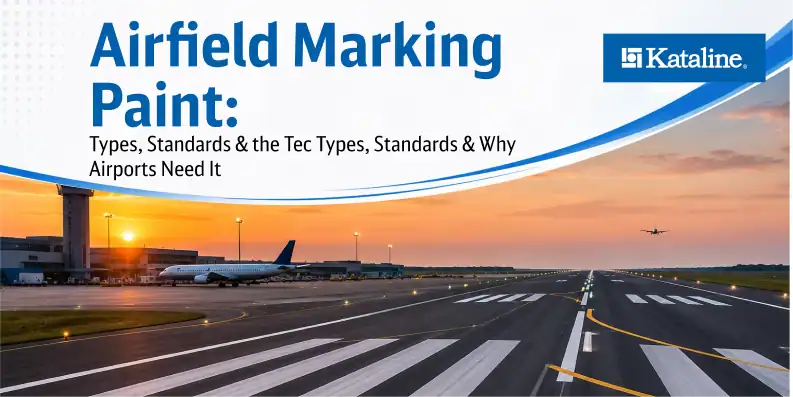
- Runway Markings Include centerlines, threshold markings, touchdown zone markings, edge markings, and designation numbers — all critical for safe landing and takeoff alignment.
- Taxiway Markings Centerlines and edge markings that guide aircraft safely between runways, aprons, and gates without deviation.
- Holding Position Markings Indicate points where aircraft must stop before entering a runway or specific controlled zone, critical for preventing runway incursions.
- Apron and Gate Markings Guide aircraft parking, gate alignment, and ground vehicle movement in high-traffic, congested areas near terminals.
- Safety and Hazard Markings Highlight closed sections, construction zones, or areas unsuitable for aircraft movement.
Standards and Compliance for Airfield Marking Paint
Airfield marking materials are typically required to meet specifications such as:
- ICAO Annex 14 guidelines on aerodrome design and markings
- National civil aviation authority standards, which may reference international specifications like BS 3262 for thermoplastic and paint materials
- Reflectivity and luminance benchmarks to ensure visibility under aircraft landing lights and in adverse weather
- Skid resistance requirements, particularly for markings near touchdown zones
Materials used often include specially formulated thermoplastic resins, chemical-resistant paints, and reflective glass bead systems designed to meet these compliance thresholds.
Key Properties of High-Quality Airfield Marking Paint
- High durability under repeated heavy aircraft loading and jet blast
- Fuel and chemical resistance for apron and refueling zone applications
- Fast curing time to minimize runway or taxiway closure duration
- High luminance and reflectivity for night and low-visibility operations
- Weather resistance across extreme temperature ranges and monsoon conditions
- Compliance with ICAO and applicable national aviation standards
Application Process for Airfield Marking Paint
- The airfield surface is thoroughly cleaned and prepared to ensure proper adhesion.
- Precise measurements are taken to meet exact regulatory dimensions for each marking type.
- The paint or thermoplastic material is applied using specialized airfield marking equipment.
- Reflective glass beads are embedded where required for enhanced night visibility.
- The marking is cured and inspected for compliance with reflectivity, dimension, and color standards before the surface is reopened to operations.
Conclusion
Airfield marking paint plays a mission-critical role in aviation safety, guiding pilots and ground crews through some of the highest-stakes operational environments in transportation infrastructure. From jet-blast resistance to strict ICAO compliance, every aspect of airfield paint formulation is designed around precision, durability, and visibility. As air traffic continues to grow, the demand for reliable, standards-compliant airfield marking solutions remains a critical component of airport infrastructure planning.
Frequently Asked Questions
What makes airfield marking paint different from regular road paint?
Airfield marking paint is formulated to withstand jet blast, fuel exposure, and heavy aircraft loads, while meeting stricter aviation reflectivity and compliance standards than standard road marking paint.
What standards govern airfield marking paint?
Airfield markings are typically governed by ICAO Annex 14 guidelines and national civil aviation authority regulations, often referencing material specifications such as BS 3262.
What types of markings are used on airfields?
Common airfield markings include runway centerlines, threshold and touchdown zone markings, taxiway centerlines, holding position markings, and apron/gate markings.
Why is reflectivity important in airfield marking paint?
High reflectivity ensures markings remain clearly visible to pilots during night operations, fog, and rain, which is critical for safe landing, takeoff, and taxiing.
Can the same thermoplastic material used on roads be used on airfields?
Not typically without modification — airfield-grade thermoplastic materials require additional fuel resistance, precise compliance dimensions, and higher durability standards compared to standard road-grade thermoplastic paint.
Latest Blogs
-
 Coloured Road Surfacing Explained: Uses in Cycle Lanes, Bus Lanes & Traffic Calming
 -
 Cold Plastic Road Marking Paint: How It Works and Where It's Used
 -
 Airfield Marking Paint: Types, Standards & Why Airports Need It
 -
 High Friction Road Surfacing: What It Is and Why It Improves Road Safety
 -
 What Is a Black Spot on the Road? Meaning, Causes & How to Identify One
 -
 What Is Thermoplastic Road Marking Paint? A Complete Guide to Safer and More Durable Road Markings