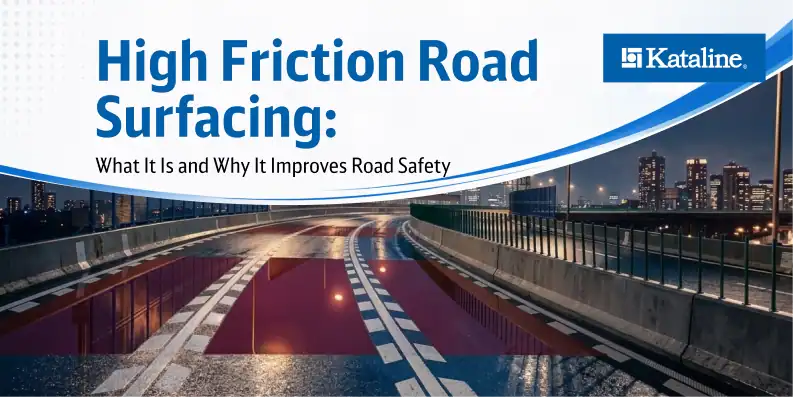
High friction surfacing is a specialized road treatment applied over existing asphalt or concrete to significantly increase skid resistance between a vehicle’s tyres and the road surface. It is commonly installed at locations requiring extra stopping power – such as junctions, sharp bends, pedestrian crossings, school zones, and accident-prone stretches – to reduce braking distances and lower the risk of skid-related crashes.
Table of Contents
ToggleWhat Is High Friction Surfacing?
High friction surfacing (HFS) is a thin, durable overlay system bonded onto an existing road surface using a high-strength resin binder combined with hard aggregate particles, typically calcined bauxite. This aggregate is significantly harder and more angular than standard road stone, which dramatically increases the surface’s grip, or “coefficient of friction,” compared to regular asphalt or concrete.
Unlike a full resurfacing project, high friction surfacing is applied as a targeted treatment at specific high-risk locations rather than across an entire road network, making it a cost-effective, localized safety intervention.
How Does High Friction Surfacing Work?
The surfacing works by increasing the mechanical interlock between a vehicle’s tyres and the road:
- A resin binder (typically epoxy, polyurethane, or a modified bituminous compound) is applied to the cleaned and prepared road surface.
- A layer of high-PSV (Polished Stone Value) aggregate, most commonly calcined bauxite, is spread and bonded into the resin while it is still workable.
- Excess loose aggregate is swept away once the resin has cured, leaving a rough, high-grip surface texture.
- The result is a surface with significantly higher skid resistance than standard asphalt, particularly in wet conditions.
Why High Friction Surfacing Matters for Road Safety
- Shorter Braking Distances The primary benefit of high friction surfacing is a measurable reduction in stopping distance, especially important at locations where vehicles need to decelerate quickly — such as approaches to junctions, roundabouts, and pedestrian crossings.
- Reduced Skidding in Wet Conditions Standard road surfaces lose a significant portion of their grip in rain. High friction surfacing retains much more of its skid resistance even when wet, directly reducing wet-weather accident risk.
- Improved Safety at High-Risk Locations Locations such as sharp bends, steep descents, school zones, and identified black spots benefit disproportionately from HFS because these are precisely the areas where sudden braking is most likely to be needed.
- Long-Lasting Durability High friction surfacing systems are engineered to withstand heavy traffic loads and repeated braking stress without rapid deterioration, offering a long service life relative to the safety benefit delivered.
- Visual Distinction HFS is often applied in a distinct color (commonly red or buff) at pedestrian crossings and school zones, which serves a dual purpose — improving both skid resistance and driver awareness of an upcoming hazard.
Where Is High Friction Surfacing Typically Used?
- Approaches to signalized junctions and roundabouts, where vehicles must stop reliably
- Pedestrian crossings and zebra crossings, especially near schools
- Sharp bends and curves on rural or hill roads
- Steep gradients and descents, where braking demand is higher
- Identified black spots with a history of skid-related accidents
- Toll plazas and speed-reduction zones, where consistent braking performance is critical
- Airport taxiways and aprons, where controlled deceleration is essential
High Friction Surfacing vs. Standard Road Surfacing
Standard asphalt or concrete surfaces are designed primarily for general durability and cost efficiency across long stretches of road. High friction surfacing, by contrast, is a targeted safety product — applied only where enhanced grip is operationally necessary. The key differences lie in the aggregate used (calcined bauxite vs. standard stone), the binder system, and the significantly higher upfront cost per square metre, which is justified by its concentrated safety impact at high-risk points.
Conclusion
High friction surfacing addresses one of the most direct causes of road accidents: insufficient tyre grip at critical braking points. By targeting junctions, crossings, bends, and known black spots with this specialized treatment, road authorities can meaningfully reduce skid-related crashes without the cost of full-scale resurfacing. As accident data continues to guide infrastructure investment, high friction surfacing remains one of the most effective, localized tools available for improving road safety.
FAQ's
What is high friction surfacing made of?
It typically consists of a resin binder (epoxy or polyurethane-based) combined with a hard, angular aggregate such as calcined bauxite, which is bonded onto the existing road surface.
Where is high friction surfacing usually applied?
It is commonly applied at junctions, roundabouts, pedestrian crossings, sharp bends, steep gradients, school zones, and locations identified as accident black spots.
Does high friction surfacing work in wet weather?
Yes – one of its primary advantages is that it retains significantly more skid resistance than standard road surfaces when wet, directly reducing wet-weather braking risk.
How long does high friction surfacing last?
Service life varies by traffic volume and binder system used, but high friction surfacing is generally engineered for long-term durability under heavy, repeated braking loads.
Is high friction surfacing the same as coloured road surfacing?
Not exactly – while high friction surfacing can be applied in color for visual distinction, its primary function is skid resistance, whereas coloured road surfacing is typically used for lane distinction, traffic calming, or wayfinding purposes.
Latest Blogs
-
Coloured Road Surfacing Explained: Uses in Cycle Lanes, Bus Lanes & Traffic Calming
-
 Cold Plastic Road Marking Paint: How It Works and Where It's Used
 -
Airfield Marking Paint: Types, Standards & Why Airports Need It
-
High Friction Road Surfacing: What It Is and Why It Improves Road Safety
-
What Is a Black Spot on the Road? Meaning, Causes & How to Identify One
-
 What Is Thermoplastic Road Marking Paint? A Complete Guide to Safer and More Durable Road Markings